你列出的四类基本正确,已经覆盖了 LLM inference 中主要的显存消耗。不过从 SGLang / vLLM / TensorRT-LLM 的工程实现来看,我建议进一步拆分成 7 类,尤其要区分 persistent allocation、runtime workspace 和 allocator reserved memory。
1. LLM Inference 显存分类
| 分类 | 显存内容 | 生命周期 | 主要影响因素 |
|---|---|---|---|
| 1. Model Weights | 模型权重及其分片 | Persistent | 参数量、dtype、TP/EP/PP |
| 2. KV Cache | 预分配 KV Cache Pool | Persistent | token capacity、KV dtype、attention 架构 |
| 3. CUDA Graph | Graph private memory pool、capture 相关 buffer | Persistent | capture shapes、batch sizes、graph 数量 |
| 4. Runtime Workspace | Attention、GEMM、MoE、通信等临时 buffer | Temporary / Reusable | batch size、token 数、kernel 实现 |
| 5. Activation / Intermediate Tensors | forward 中间张量、hidden states、logits | Temporary / Reusable | token 数、hidden size、执行计划 |
| 6. Framework & Allocator | PyTorch caching allocator、内存碎片、预留块 | Persistent / Reusable | allocator 策略、分配模式 |
| 7. CUDA / Library / Communication Context | CUDA context、cuBLAS、NCCL、通信 buffer | Mostly Persistent | GPU 架构、CUDA 库、TP/EP 通信 |
这里有两个容易混淆的地方:
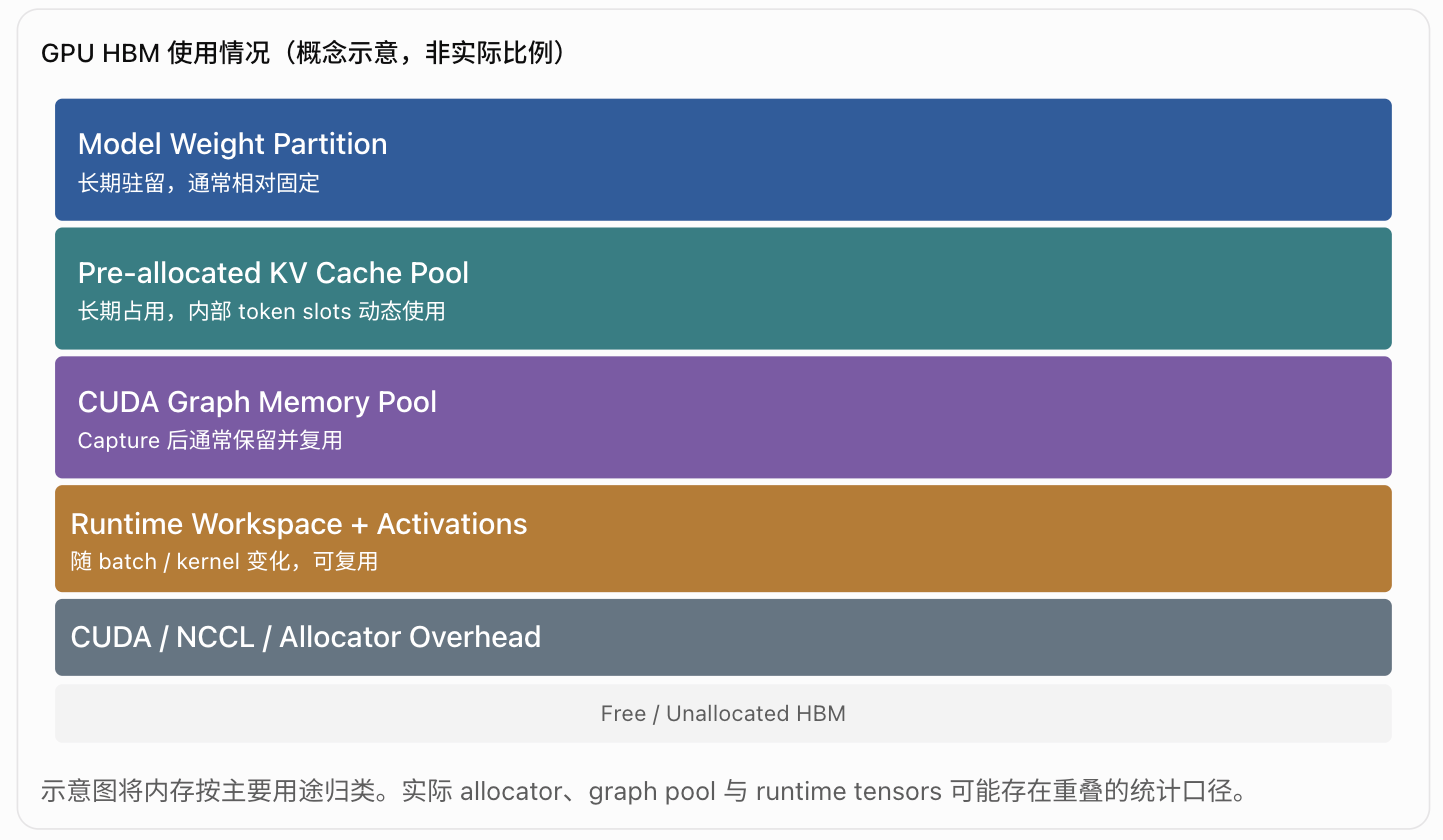
- Runtime Workspace 和 Activation:前者一般是 kernel 或 library 执行需要的 scratch space,后者是模型计算产生的逻辑张量。两者可能共用 allocator,也可能被 CUDA Graph 捕获。
- CUDA Graph 和 Allocator:CUDA Graph 的 private pool
本身也属于 allocator 管理的显存,不能简单把
memory_reserved()、graph pool 和 activation 占用相加,否则可能重复计算。
各类显存的细节见以下子页:
| 子页 | 覆盖内容 |
|---|---|
| 显存预算与统计口径 | 启动时从总显存推导 KV
容量;allocated/reserved/NVML
各统计什么;逻辑用途与物理分配 |
| 常驻显存:权重与 KV Cache | 权重分片的字节账;不同 attention 架构每 token 的 KV 字节 |
| 运行时显存:激活、Workspace 与峰值 | 激活与 workspace 的区别;Prefill/Decode 峰值;CUDA Graph 对峰值的影响 |
| 通信与传输显存 | NCCL、custom all-reduce、DeepEP buffer;PD 分离的注册内存 |
2. 从显存生命周期理解
3. 还有哪些容易遗漏的显存?
在你实际做的大模型推理场景中,我会特别关注以下几项。
A. MoE 相关 buffer
尤其是 EP 和 DeepEP 场景:
- Token dispatch / combine buffer
- All-to-all communication buffer
- Expert routing metadata
- Permutation / unpermutation buffer
- Quantization scale / intermediate buffer
其中有些 buffer 是初始化时分配的,有些与当前 token 数量有关。
B. Prefill / Decode 的显存结构不同
| Prefill | Decode | |
|---|---|---|
| Weights | 相同分片策略下基本一致 | 相同分片策略下基本一致 |
| KV Cache | 持续写入 | 持续读取和追加 |
| Activation | 通常更大,随 chunk tokens 增长 | 通常较小,随 active batch 增长 |
| Attention workspace | 取决于 prefill kernel | 取决于 decode kernel |
| CUDA Graph | 不一定使用 | 通常更依赖 |
| Communication buffers | 受 TP/EP 和 token 数影响 | 受 TP/EP 和 batch 影响 |
C. PD Disaggregation 专用内存
Prefill / Decode 分离时,还需要考虑:
- KV transfer staging buffer
- RDMA / NVLink transfer buffer
- Registered memory
- Transfer metadata
- 双缓冲(double buffering)
需要注意,RDMA 注册内存不一定是 GPU HBM,也可能是 pinned host memory,因此不能全部算进显存。
4. 显存统计的一个重要陷阱
在 PyTorch 中:
torch.cuda.memory_allocated()
torch.cuda.memory_reserved()
这两个值不能代表完整的 GPU 显存使用量。
例如:
- PyTorch allocator 管理的权重和 activation 通常可以统计。
- CUDA context、NCCL、第三方直接调用
cudaMalloc的分配可能不在其中。 memory_reserved()包含已分配给张量的内存,并不是额外的一份显存。nvidia-smi/ NVML 能看到更接近进程级的实际显存占用,但无法直接区分各个用途。
所以在 profiling 时,最好同时记录 PyTorch allocator 指标、NVML 指标,以及各个初始化阶段的显存增量。
5. 我建议最终采用的分类
如果你想形成一套适合 SGLang / vLLM 源码阅读、显存预算和 OOM Debug 的知识体系,可以按以下结构组织:
LLM Inference GPU Memory
│
├── 1. Model Persistent Memory
│   ├── Model Weight Partition
│   ├── Quantization Scales / Metadata
│   └── Persistent Model Buffers
│
├── 2. KV Cache Memory
│   ├── KV Cache Pool
│   ├── KV Index / Page Metadata
│   └── KV Transfer Buffers (PD)
│
├── 3. CUDA Graph Memory
│   ├── Graph Private Pool
│   └── Static Input / Output Buffers
│
├── 4. Runtime Tensor Memory
│   ├── Activations
│   ├── Intermediate Tensors
│   └── Logits / Sampling Buffers
│
├── 5. Kernel Workspace
│   ├── Attention Workspace
│   ├── GEMM Workspace
│   └── MoE Workspace
│
├── 6. Communication Memory
│   ├── NCCL Buffers
│   ├── DeepEP Buffers
│   └── RDMA / Transfer Buffers
│
└── 7. System & Allocator Overhead
    ├── CUDA Context / Libraries
    ├── Allocator Cached Blocks
    └── Fragmentation
最重要的工程区分是:显存的逻辑用途与物理分配方式是两个不同维度。
例如,一个 activation tensor 可能由 PyTorch caching allocator 分配,也可能位于 CUDA Graph private pool;一个 DeepEP buffer 可能是初始化时永久分配的,并不属于动态 runtime allocation。
因此,在做显存预算时,应该按实际独立分配的物理内存计算,而不是机械地将上述七类相加。
对于你做的 MoE + PD 分离推理,最值得深入研究的是:KV Cache Pool、CUDA Graph Pool、MoE/DeepEP Communication Buffer,以及 Runtime Peak Activation。这四项往往是模型权重之外,决定实际可用 token capacity 和 OOM 边界的关键因素。